- Home
- News
- Combining the GWC + Rotating Hook Restraints for Streamlined, Full-Time Safety and Communication at the Loading Dock|
How to Fully Secure 100% of Trailer Types at a Mixed-Use Loading Dock
How to Secure Multiple Trailer Types at a Mixed-Use Loading Dock
Loading docks today handle a wider variety of vehicles than ever before. As traffic patterns shift and volumes increase, facilities are no longer servicing just standard trailers. RIG-equipped trailers now share dock space with intermodal chassis, yard trucks, straight trucks, and other non-RIG vehicles, creating new challenges for maintaining consistent and reliable vehicle restraint.
Many facilities rely on a single type of restraint system, either wheel-based or RIG-based. In mixed-use environments, that approach can create gaps in protection and lead to inconsistent communication.
These gaps result in:
- Increased risk of trailer separation accidents
- Operator confusion and workarounds
- Inconsistent safety signaling across the dock
Where Single-System Approaches Fall Short
Rotating hook restraints secure trailers by engaging the Rear Impact Guard (RIG), creating a secure connection between the trailer and the building. They work effectively across most standard trailers, including intermodal chassis and obstructed RIGs.
However, they cannot properly engage trailers where the RIG is not present or damaged, or liftgate-equipped trailers and most parcel delivery vehicles. Wheel-based systems are often used in these situations by securing the tires.
Each solution performs as engineered, but neither addresses every scenario on its own. Rotating hook restraints provide a high level of protection against horizontal and vertical trailer separation accidents for RIG-equipped trailers, while wheel-based systems help protect against horizontal accidents while covering applications where RIG engagement is not possible.
The result is a gap in coverage that can introduce variability in both safety and operations. The goal is to reduce risk across the widest range of real-world conditions.
A More Complete Approach
A combined system pairs new or existing Rite-Hite rotating hook restraints for RIG-equipped trailers with a communication-enabled wheel-based system for non-RIG trailers, allowing facilities to adapt as traffic changes.
This ensures that each trailer is secured using interlocked safety equipment, not workarounds.
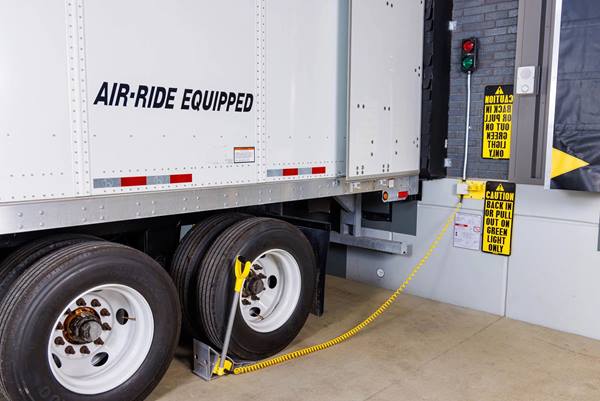
Wheel-based systems such as the Global Wheel Chock (GWC-1000), pictured above, secure vehicles by engaging the rear wheel. They are designed to secure:
- Straight trucks
- Yard tractors
- Intermodal chassis
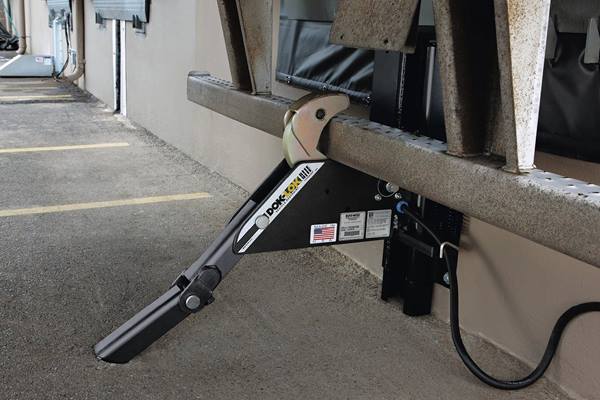
Rotating hook restraints secure RIG-equipped trailers by engaging the RIG, helping prevent early departure, trailer creep, and landing gear collapse. Available options include:
- GRH-100: Entry-level rotating hook restraint for standard applications
- RHR-1100: Rotating hook restraint designed for mixed fleets and long-term safety performance
- SHR-5100: High-performance rotating hook restraint for demanding and complex loading dock environments.
Together, these systems create a consistent approach across all vehicle types, reducing variability and improving safety at the dock.
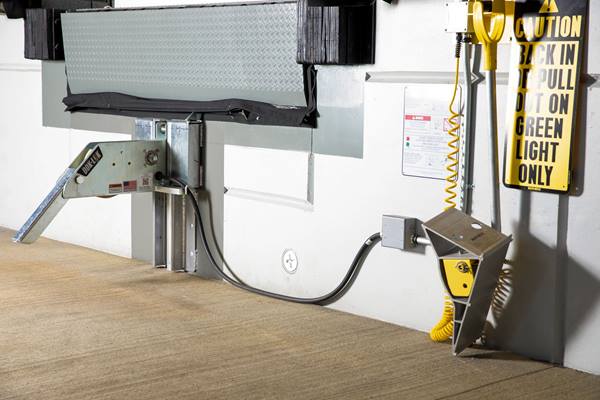
Consistent Protection Across Every Load
With both systems in place at one dedicated dock position, facilities can:
- Secure virtually all vehicle types at the dock
- Reduce or eliminate manual chocking
- Standardize procedures across shifts
- Minimize exceptions and workarounds
Instead of changing processes based on trailer type, teams can follow one consistent approach.
One Dock, One Clear Signal
Physical restraint is only part of dock safety. Clear communication is just as critical.
A combined system delivers a unified communication approach across all vehicle types. Drivers and dock workers see the same red and green signals at all times, reducing confusion and improving coordination.
When integrated with systems like Dok-Commander Pro, Rite-Vu, Approach-Vu, and Lok-Vu, teams gain real-time visibility across the dock and operate from a shared understanding of status and activity.
Operational Benefits
Standardizing safety helps improve both protection and performance:
- Fewer trailer separation incidents
- Reduced liability exposure
- Simplified training regardless of experience
- More consistent operations across shifts and locations
Which Combination Is Right for Your Dock?
- High-volume, demanding, and diverse loading dock environments
→ GWC-1000 + SHR-5100
- Mixed fleets with moderate traffic and long-term safety goals
→ GWC-1000 + RHR-1100
- Lower-volume operations focused on safety improvements
→ GWC-1000 + GRH-100
Move to a System-Based Approach
Dock safety should not depend on trailer type or manual processes.
Combining wheel-based and rotating hook restraints creates a consistent, engineered approach that reduces variability and improves safety across every load.
Evaluate your current setup to identify gaps and determine how a combined system can help close them.
Find a Rep Contact Us